It will take just a few seconds...
You are on the Next Part
Please click to continue
You are on the Next Part
Please click to continue
You are on the Next Part
Please click to continue
You are on the Next Part
Please click to continue
You are on the Next Part
Please click to continue
You are on the Next Part
Please click to continue
You are on the Next Part
Please click to continue
You are on the Next Part
Please click to continue
Verbal Aptitude is the ability to understand and respond to information expressed in words. It will evaluate your ability to think constructively with words.
Look at the word in capital letters. There are four options - A, B, C and D given after the word. Find the word which means the same thing as the word in capital letters. (See Example 1)
Read the proverb in bold letters. Then, choose the correct meaning of the proverb from the options A, B, C, D and E given below the proverb. (See Example2).
In the above example, note that ESSENTIAL and Necessary mean the same thing. Therefore option “A” is the correct answer.
Number of questions-25. Time Limit-10 minutes
In this example,ATTEMPT and TRY means the same thing. Therefore, the right answer for ATTEMPT is “Option A- TRY.
ATTEMPTIn this example, the related meaning for the proverb “THE GRASS IS ALWAYS GREENER ON THE OTHER SIDE” is “People always want what they do not have”. Therefore, right answer is “option C”.
Verbal Aptitude is the ability to understand and respond to information expressed in words. It will evaluate your ability to think constructively with words.
Look at the word in capital letters. There are four options - A, B, C and D given after the word. Find the word which means the same thing as the word in capital letters. (See Example 1)
Read the proverb in bold letters. Then, choose the correct meaning of the proverb from the options A, B, C, D and E given below the proverb. (See Example2).
In the above example, note that ESSENTIAL and Necessary mean the same thing. Therefore option “A” is the correct answer.
Number of questions-25. Time Limit-10 minutes
In this example,ATTEMPT and TRY means the same thing. Therefore, the right answer for ATTEMPT is “Option A- TRY.
ATTEMPTIn this example, the related meaning for the proverb “THE GRASS IS ALWAYS GREENER ON THE OTHER SIDE” is “People always want what they do not have”. Therefore, right answer is “option C”.
Numerical Aptitude refers to understanding the numerical relationships and applying the same to the issue or problem in hand.
Each numerical problem is followed by four given options - A, B, C, and D. You have to tick the correct answer.
Keep a paper readily available for rough calculations. Work as quickly as you can to finish as many problems as you can. If you are not sure of the right answer for a problem, mark the choice that is your best guess.
Number of questions-20. Time Limit-10 minutes
Example 1: In this example on adding 74 with 333, we get 407 as the right answer. So option A is the right answer.
Numerical Aptitude refers to understanding the numerical relationships and applying the same to the issue or problem in hand.
Each numerical problem is followed by four given options - A, B, C, and D. You have to tick the correct answer.
Keep a paper readily available for rough calculations. Work as quickly as you can to finish as many problems as you can. If you are not sure of the right answer for a problem, mark the choice that is your best guess.
Number of questions-20. Time Limit-10 minutes
Example 1: In this example on adding 74 with 333, we get 407 as the right answer. So option A is the right answer.
Mechanical Aptitude refers to an understanding of basic mechanical principles, simple machines, tools, electrical facts, etc.
In this test, you will answer questions about mechanical facts and principles by marking one of the four choices given. Sometimes, there will be a picture with the question; sometimes not. Work as quickly as you can. If you are not sure of the right answer mark the choice that is your best guess.
Number of questions-20. Time Limit-10 minutes
A device that does the same thing as a fuse is called circuit breaker. Therefore,
Option D is the right answer.
Mechanical Aptitude refers to an understanding of basic mechanical principles, simple machines, tools, electrical facts, etc.
In this test, you will answer questions about mechanical facts and principles by marking one of the four choices given. Sometimes, there will be a picture with the question; sometimes not. Work as quickly as you can. If you are not sure of the right answer mark the choice that is your best guess.
Number of questions-20. Time Limit-10 minutes
A device that does the same thing as a fuse is called circuit breaker. Therefore,
Option D is the right answer.
Perceptual Aptitude refers to a person’s ability to quickly, accurately and meaningfully compare visual information, i.e. letters and patterns.
In this test you will see a word followed by four ‘jumbled ‘words. Find, among the four Jumbled choices, the one that has the right letters to spell the word. Work quickly to finish as many items as you can. If you are not sure of the right answer, mark the choice that is your best guess.
Number of questions-20. Time Limit-6 minutes
“Rweat” has all the letters for forming the word “Water”, so Option B is the right answer.
“Eusscsc” has all letters of word “Success” so Option C is the right answer.
Perceptual Aptitude refers to a person’s ability to quickly, accurately and meaningfully compare visual information, i.e. letters and patterns.
In this test you will see a word followed by four ‘jumbled ‘words. Find, among the four Jumbled choices, the one that has the right letters to spell the word. Work quickly to finish as many items as you can. If you are not sure of the right answer, mark the choice that is your best guess.
Number of questions-20. Time Limit-6 minutes
“Rweat” has all the letters for forming the word “Water”, so Option B is the right answer.
“Eusscsc” has all letters of word “Success” so Option C is the right answer.
Clerical Aptitude test assesses a person’s abilities in areas relevant to clerical or administrative roles, such as typing speed and accuracy, data entry, numerical reasoning and critical thinking. It is a person’s proficiency at tasks related to administrative or clerical work.
This test contains 50 pairs of letters or numbers, which are either similar or different. If the pair is exactly the same, mark the S box. If the pair is different in any way, mark the D box
Number of questions-50. Time Limit-6 minutes
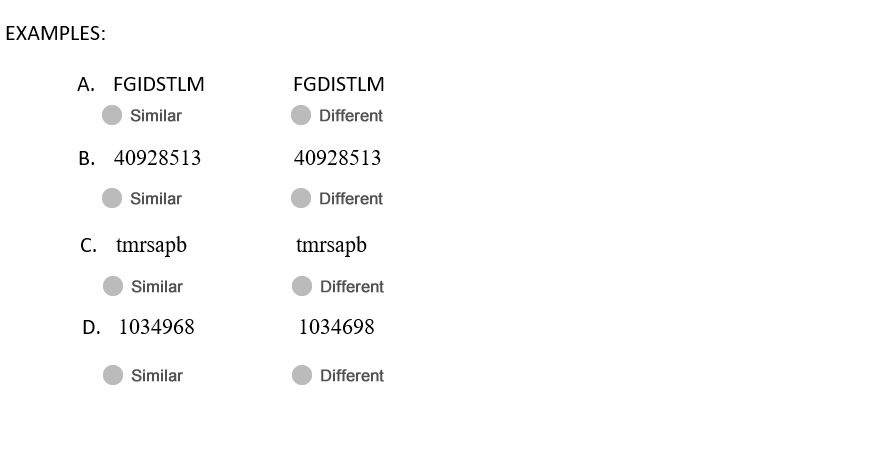
Look at the examples below. Mark “Similar” if both the parts of a pair are the same.
Mark “Different” if both the parts are different in any way.

In the above examples B and C both parts of each pair were the same. Therefore Option “Similar” is right answer for them.
In examples A and D, the parts of each pair were different. Therefore Option “Different” is right answer for them.
This Clerical Aptitude assesses proficiency at tasks related to clerical or administrative work.
This test contains 50 pairs of letters or numbers, which are either similar or different. If the pair is exactly the same, mark the S box. If the pair is different in any way, mark the D box
Number of questions-50. Time Limit-6 minutes
Look at the examples below. Mark “Similar” if both the parts of a pair are the same.
Mark “Different” if both the parts are different in any way.

In the above examples B and C both parts of each pair were the same. Therefore Option “Similar” is right answer for them.
In examples A and D, the parts of each pair were different. Therefore Option “Different” is right answer for them.
Spatial ability is concerned with perceiving patterns accurately and following the orientation of figures when their position in a plane or space is altered.
In this test, there are drawing of all kinds of figures and you have to imagine them in different positions.
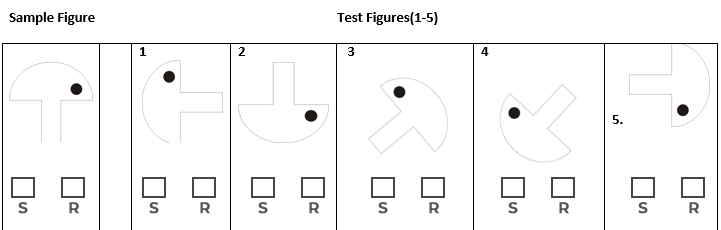
In each row, in left column, there is one figure- called “sample figure”. The Sample Figure is followed by five “Test Figures” some of the test figures will be the same as the sample figure, but just turned “around”.
In some cases, the test figure will be reversed, that is turned “over” and turned “around”. Identify whether the given test figure is the same (S) or reversed (R) from the sample figure and mark the box “S” or “R”. Be sure to mark S or R for each of the test figure in each row.
Number of questions-50. Time Limit-10 minutes
Look at each one of the five test figures 1-5 below. Decide whether it is the same (S) or reversed (R) from the sample figure.
Spatial ability is concerned with perceiving patterns accurately and following the orientation of figures when their position in a plane or space is altered.
In this test, there are drawing of all kinds of figures and you have to imagine them in different positions.
In each row, in left column, there is one figure- called “sample figure”. The Sample Figure is followed by five “Test Figures” some of the test figures will be the same as the sample figure, but just turned “around”.
In some cases, the test figure will be reversed, that is turned “over” and turned “around”. Identify whether the given test figure is the same (S) or reversed (R) from the sample figure and mark the box “S” or “R”. Be sure to mark S or R for each of the test figure in each row.
Number of questions-50. Time Limit-10 minutes
Look at each one of the five test figures 1-5 below. Decide whether it is the same (S) or reversed (R) from the sample figure.
Reasoning ability refers to a person’s ability for logical and analytical thinking.
Number of questions-20. Time Limit-8 minutes
In each row, you will get four sets of letters. Three of the four sets follow a certain rule, but one set does not. You have to mark one set that does not follow the rule or which is ‘Odd One Out’. (See Example 1)
Example 1
Here you can see that four of the sets, the first two letters are the same. In the option "D"- FXZP, the rule is not followed, , so it is ‘Odd One Out’ and the correct answer is “D”.
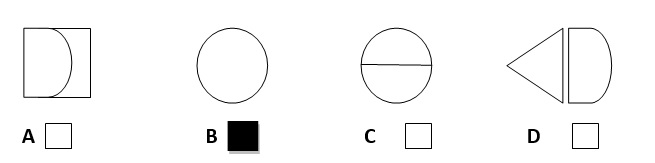
You will see rows of designs or figures like those given below in the example. Each row consists of four figures which follow a certain rule but one figure amongst them does not. You have to mark the Alphabet of the one figure that does not follow the rule or which is ‘Odd One Out’. (See example-2).
If you are not sure of the right answer for an item, mark the choice that is your best guess. Rules are not based on sounds, shapes or types (vowel or consonant) of the letters.
In the above-mentioned Example, B is the correct answer. It is the only curved shape does not have a straight line.
Reasoning ability refers to a person’s ability for logical and analytical thinking.
Number of questions-20. Time Limit-8 minutes
In each row, you will get four sets of letters. Three of the four sets follow a certain rule, but one set does not. You have to mark one set that does not follow the rule or which is ‘Odd One Out’. (See Example 1)
Example 1
Here you can see that four of the sets, the first two letters are the same. In the option "D"- FXZP, the rule is not followed, , so it is ‘Odd One Out’ and the correct answer is “D”.
You will see rows of designs or figures like those given below in the example. Each row consists of four figures which follow a certain rule but one figure amongst them does not. You have to mark the Alphabet of the one figure that does not follow the rule or which is ‘Odd One Out’. (See example-2).
If you are not sure of the right answer for an item, mark the choice that is your best guess. Rules are not based on sounds, shapes or types (vowel or consonant) of the letters.
In the above-mentioned Example, B is the correct answer. It is the only curved shape does not have a straight line.
The PSS Central Institute of Vocational Education (PSSCIVE), a constituent unit of National Council of Educational Research and Training (NCERT) has developed this Skill based Aptitude assessment tool. The tool has been designed and developed for the students of Class X by group of experts on the behest of the Ministry of Education, Government of India.
The students after completing the upper primary stage should be provided opportunity to explore the various vocational opportunities in the world of work and relate their interests and aptitude with the occupations. The decision of the students in making choice of the subjects is influenced by their interests, attitudes, motivation, personality and aptitude.
The tool comprises of questions to be answered by the students of Class X, which will help them to know their interest and aptitude to choose a vocational subject or a vocation as a career. The details about use of tool, dimensions measured in the tool, administration and scoring and the use of tool scores are available online. The outcome of the assessment should not be utilized for imposing the decision on the students regarding the choice of vocational courses or other subjects. Teachers and Counsellors can utilize the outcomes of the test to guide the students.
This test is a battery of two assessments-
Part-1- Interest Inventory-
This test will help you identify your interests and the fields that match them. The result of the test provides information related to your personality traits and personal interests. It will also help you to make an informed choice of the vocational subject or a vocation as a career.
Time Limit- No time limit.
Part-2 - Aptitude Test
This aptitude test will help you assess your abilities. It will give you a better understanding of yourselves. It is designed to reveal your strengths and weaknesses and give you a better understanding of our overall abilities, and also highlight your hidden talents.
Aptitude test covers general mental abilities like abstract reasoning, perceptual ability, clarity of thinking, etc. which assess specific abilities and fitness of the individual for a particular occupation.
Total Time Limit- 60 Mins/1 hour
Let us now familiarise ourselves with some of the terms which we will be using here
Part-1- Interest Inventory-
Interest is something that a person enjoys learning about or doing it. Interests are very much linked with our wants, motives, and basic needs. It also indicates like or dislike for something or the job responsibilities associated with an occupation. It helps a person to realize the goals.
Both interests and personality traits are motivational processes that influence individual behaviour with respect to choices, inclusive of tasks or activities in which they wish to engage. During adolescence, interests, capacities and values develop which are all aspects of a career, but career choice is still based on interests and parental influence.
Pursuing one's interest is always satisfying. You might be interested in doing something in life. For example, becoming a photographer, a musician, a tour guide, an animator, an automotive engineer, a space scientist, a progressive farmer, etc. If you are interested in doing certain activities, which are associated with some occupations, then it is the right time that you assess your interests and abilities to make a "career choice". As a student, you need to explore the various vocational opportunities in the world of work and relate your interests with the various occupations available in the world of work. Your decision in making choice of the subjects is influenced by your interests, attitudes, motivation, personality and aptitude.
Interest Inventory is a guidance instrument designed to assess your interests through an instrument comprising of items to be answered by you. It will help you to know your vocational interest and to choose a vocational subject or a vocation as a career. This assessment will measure your interest and personality traits.
This Interest Inventory instrument has been developed by a group of experts to help students identify their interests and the fields that match them. It is an inventory which will be used to help students identify their interests and personality and match them with the various disciplines or fields. The inventory comprises of questions to be answered by the students of Grade 10, which will help them to know their interests and to choose a vocational subject or a vocation as a career. It provides information related to the occupational interests of the students and should be taken up voluntarily by students. Another factor that influences the choice of career is the "personality". Personality tests measure aspects of an individual's personality that are relevant to job performance, including interaction style and behavioural tendencies. However, the correlations of interests with personality characteristics are not very strong, and an individual's personality gives only a rough guide as to his or her pattern of vocational interests.
According to John L Holland (1997), personality in most persons can be categorized as one of the following six types:
Part-2 , Aptitude Test-
The most common definition of aptitude involves an innate ability to perform an activity or task. It is, in essence, the predisposition we all come into the world with to do well in certain areas and maybe not so well in others.
Although aptitude is considered as an inborn tendency but environment also plays a significant role in the development of aptitude. An individual’s performance on a task depends on intrinsic factors such as personality characteristics, motivation, ability, etc. and on extrinsic factors such as cultural exposures, environment stimulation, family environment, quality of education, etc. For example, a person has the ability to be an engineer but due to lack of support from the school and home environment he/she may not be able to explore this occupation and may not get appropriate training in the same field. As a result, despite having an aptitude a person may not get supportive environment/proper training in that area.
This aptitude test is designed by experts to assess the abilities of an individual. Aptitude tests give a better understanding of one selves; it guides with intelligence an individual possess. It is designed to reveal strengths and weaknesses and give a better understanding of overall abilities, and also highlight hidden talents. This is important for professional development.
Earlier student’s mental ability was assessed using intelligence tests, but it did not provide any valid evidence regarding presence or absence of specific abilities and fitness of the individual for a particular occupation. But the present Aptitude test covers general mental abilities like abstract reasoning, perceptual ability, clarity of thinking, etc.
This aptitude test is divided into 7 subtests:
The details about the use of SBAT, dimensions measured in this test, administration and scoring and the use inventory scores are available online. The outcome of the test should not be utilized for imposing the decision on the students regarding the choice of vocational courses or other subjects.
Teachers and Counsellors can utilize the outcomes of the inventory to guide the students. The outcome of the inventory should not be utilized for imposing the decision on the students regarding the choice of vocational courses or other subjects.
Items were constructed related to the six dimensions of Holland RIASEC Model.
According to John L Holland (1997), personality in most persons can be categorized as one of the following six types:
The principles that were followed in the construction of items are as follows:
Items were to be developed for all the six dimensions i.e. RIASEC.
100 (50 males and 50 females) school students drawn from rural and urban areas of Bhopal were selected for the survey. The age of students ranged from 13 to 15 years, with a mean age of 13.5 years. The main objective of the pilot survey was to know:
Based on the findings of the pilot testing some changes were made in the general instructions and language of the items.
The principles that were followed in the construction of items are as follows:
Items were to be developed for all the six dimensions i.e. RIASEC.
For each respondent, the total of all the items (answer) is calculated. This total is the sum of answers of all the items of an inventory for each respondent. In other words, this total contains the contribution of all items of each respondent. This statement generates a total of 90 items for each respondent. Now there are one hundred twenty-one variables – 1 to 90 is the statements and the last (91st) is the total. Calculated correlation coefficients of the total with each item. The non-significant correlation coefficients of the items were identified by manual checking. It was revealed that these items do not contribute significantly to the total. In other words, these items are not reliable and deleted from the inventory. Finally, out of total 90 items, only 78 items were retained and the remaining 12 items were deleted.
The inventory is scored with the help of a vocational interest inventory manual. In the present inventory only two alternative responses have been given to each statement i.e. "Like" and "Dislike".
The vocational interest inventory has 78 items. Every item is to be responded to in "Like" and "Dislike". There is no other alternative. Every "Like" response is assigned 1 mark and every "Dislike" is assigned 0 marks. The sum of marks is obtained for the entire inventory. In the present study vocational interest is indicated by the total score obtained by the students on the vocational interest inventory.
The scores for each area are collected separately and the overall total is taken as the vocational interest score of the student. The student with high scores in this inventory is considered to have a high level of vocational interest and vice versa. The maximum vocational interest score of the vocational interest inventory was 13 and the minimum score was one. The Median value was calculated to put a demarcation line between highly interested and poorly interested students The vocational interest classification of students based on their respective scores are given below:
Scores 1 – 3 below Average Scores 4 - 7 Average Scores 8 – 11 above Average Scores 12 – 13 High
The correlation coefficient of these two variables, ODD TOTAL and EVEN TOTAL is calculated with the help of the Pearson correlation method. The value of the correlation coefficient comes more than .70, the inventory is called reliable, otherwise, the inventory is less reliable, and the inventory does not indicate the true picture of the measurement. The higher the value of the correlation coefficient, the more will be the reliability of the inventory.
The split-half reliability of the Vocational Interest Inventory was calculated for both the male and female students. The reliability of inventory was computed by applying the 'odd and even' procedure. The scores of 39 odds and 39 even items for the entire vocational interest inventory were correlated by using the product-moment method. The obtained reliability coefficient is given in the following table:
According to this method the inventory is administered at two points of times to the respondents. These two points means test the inventory and again retest it on the same respondents. The results of measurement were almost the same at two points of time. It was concluded that inventory is reliable.
There are seventy-eight items of the inventory (Q1 TO Q 78) and data were collected for the test from 100 respondents. Then the data were again collected with the same inventory from the same respondents at retest time (after five weeks’ gap). The data were entered into the computer in Excel. The seventy-eight questions have been labelled as Q 1 to Q 78 at a test and the names of the questions have been given as QR 1 to QR 78. The test-retest reliability of the inventory was determined by the 'test re-test reliability method' after a lapse of five weeks. The obtained reliability quotient was .74.
Content Validity:
The contents of items of each area were balanced representations. This means each area of the inventory has almost a similar number of items or questions. The contents of the inventory were related to the objectives of the inventory. This means all the items measure a common element. The content validity has moderate to high levels of internal consistency. All the items have a high level of correlation among themselves. The degree of content validity is mainly a criterion that all the items are complete and representative. The inventory developers observed that all items of an area are logically related.
Expert Validity:
Copy of the inventory was sent to seven professional experts (psychologists, counsellors, educationists, psychometricians) along with the objectives of the inventory with a request to check the validity of the inventory. Five out of seven professional experts expressed consensus and validity is confirmed. The majority of professional experts give some suggestions, and these were incorporated in the inventory and send the same to the professional experts for seeking their final opinion on the validity.
Face validity:
Face validity is the logical link between the items and the objectives of the inventory. It means each question of the inventory is related to the objectives of the inventory. The inventory developers assessed the face validity of the present inventory.